
“What Went Wrong With Capitalism”
Ruchir Sharma. Short book review.

The main point of his book (“What Went Wrong With Capitalism”. (1) ) is to elaborate on some of capitalism’s many failings, and offer a solution. Ruchir Sharma is a guy who knows this topic - he’s a fund manager, a columnist for the Financial Times, and the head of Rockefeller Capital Management's international business.
He claims that the concentration of wealth, “in the hands of oligopolies and the billionaire class, is a critical symptom of capitalism gone wrong …”. He’s also puzzled that, “the productivity slump is the most important mystery of modern capitalism …”.
Not only that, “Since the 1970s, the average rate of per capita income growth fell worldwide from nearly 3 percent a year to under 1 percent …”
The state of affairs today is so dreadful that, “By 2020, only half of American adults under forty approved of capitalism, a third were willing to try communism as an alternative …”.
So, it’s getting serious!
The blame for these and other failures lies not with capitalism itself, however, but with government, and too much state intervention.
Many capitalist apologists have offered very similar analyses - leave capitalism alone and everything will be fine. If you try to regulate it, or somehow make it more equitable, or even more efficient, you’ll only make it worse. This narrative is hardly new. Way back in 1844, for example, The Economist argued that, “in any interference with industry and capital, the law is powerful only for evil, but utterly powerless for good.” (2)
Nonetheless, Sharma goes ahead and elaborates on all the ways in which state intervention leads to bad things.
He disputes the widely held notion that the state has shrunk, following the victory of neoliberalism and “shareholder value” theory.
On the contrary, he suggests that the state has not been “hollowed out” or marginalised. It has grown, in scale and scope. It is now smothering capitalism’s natural dynamism, its “competitive fire”. As though substantiating The Economist’s warnings of the 19th century, this has led not only to bloated monopolies, oligopolies, and the super rich, but also to widespread poverty and economic uncertainty for many millions.
It follows then, he suggests, that governments must stop subsidising and bailing firms out; stop endlessly cultivating the idea that governments will always “save us” from bankruptcies, from poorly managed “zombie” firms; stop creating rules, bureaucracy, guidance. Oh, and stop borrowing money and lending it at artificially low rates.
Too much molly-coddling! “Firms should be allowed to fail”, he says. Democracies are, “losing the capacity to make hard choices”. The choices being, presumably, to let firms collapse and throw people out of work.
When capitalism is working, he says, “it gives people freedom to vote in the marketplace, by investing in new ideas and growing companies”. Call it “market democracy”.
This would of course give some people rather more democracy than others! It seems like another idea that’s been around since the first stirrings of democratic government - the restriction of the franchise to, “men of property”.
Rich conservatives have never been happy with democracy. For example, a scion of the British Conservative Party, Ian Gilmour (now deceased) said in his book, “Inside Right”(3) that, “Conservatives do not worship democracy. For them, majority rule is a device... Democracy is a means to an end, not an end in itself.”
This “market democracy” would of course provide a very large number of “votes” to a very small number of people.
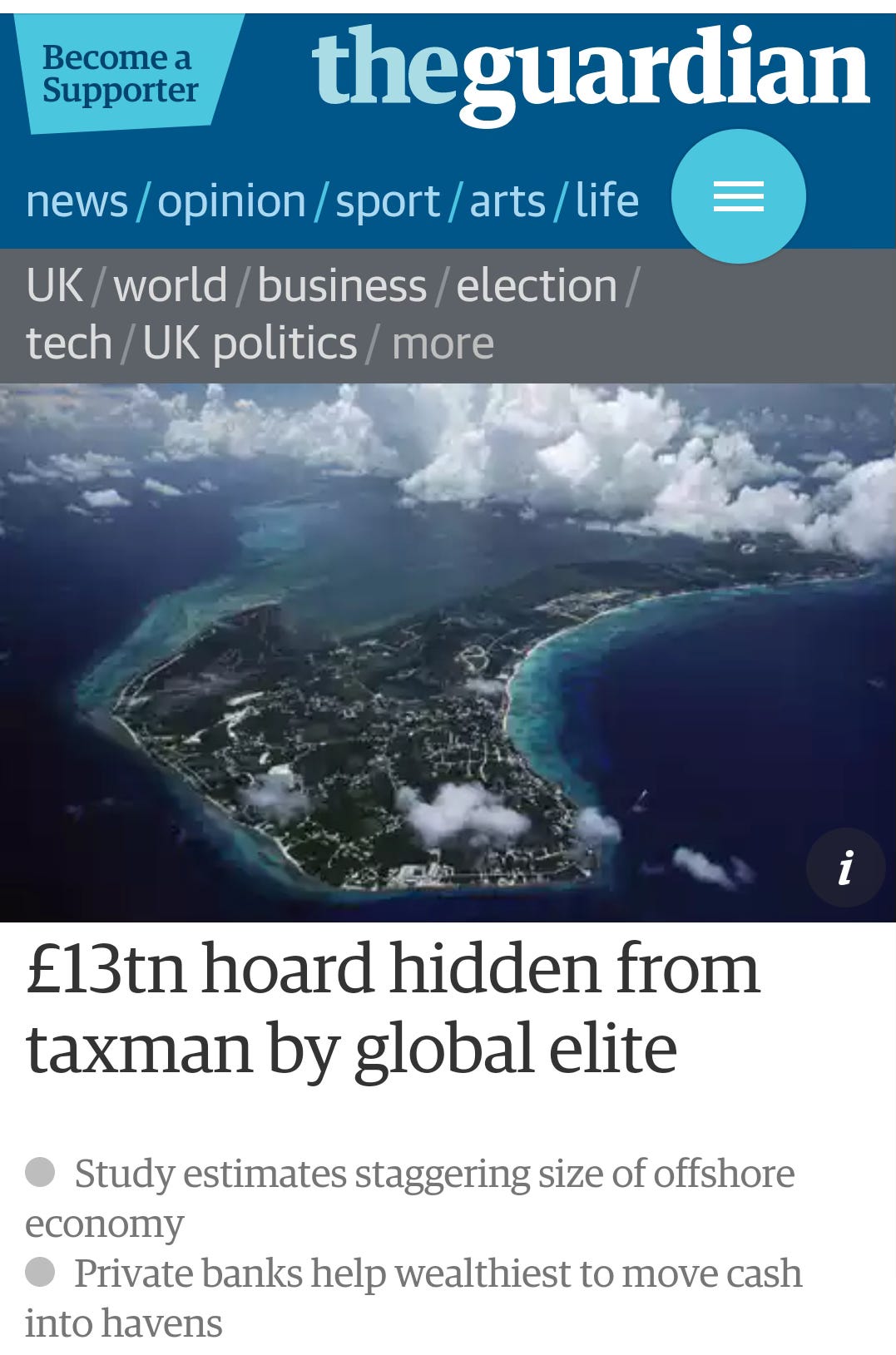
Consider the scale of it. In January this year the Financial Times reported on the spread of stock ownership of the US public. It revealed that, “The wealthiest 10% own 92.5% of the market — a “record high concentration”... And while the richest 1% owned just 40% twenty years ago, their share stood at 54% in the most recent data from 2022”. (My emphasis).
So the “market voting power” of poorest 90% would be proportional to their collective ownership of around 8% of the total market.
Capitalism will of course always look after itself. It already works very well indeed for plutocrats. What Sharma hopes to do, like many before him, is convince a wider audience that there’s nothing we can do to change it. To try, will only make it worse.
Let’s convince people that capitalism is “natural”, that it’s aligned and in perfect harmony with “human nature”, or it’s an unthinking “machine”.
He states, “Capitalist leaders have come to think and speak of the market economy as a machine, controlled by human engineers who have the power to “fine tune” this “engine” of growth. But the economy is less a machine than a natural ecosystem, less an engine than a complex organism, like a forest or ocean”.
I must say, I’ve never before heard capitalism compared to a forest or an ocean!
But he is right about one thing; something often overlooked.
It is not possible to make capitalism work for the general good. Yes, there are periods when socially beneficial change can be achieved, but only for relatively short periods, when the balance of forces is tilted in Labour’s favour (such as the period following WW2). Then it gets tilted back again, as it did from the 1980s going forward, when big capital regained the upper hand.
This is the nature, not of oceans or forests, but of capitalism, that is, class society. As Warren Buffet memorably remarked, “There’s class warfare all right, but it’s my class, the rich class, that’s making war, and we’re winning.”
When I’d finished the book I was left thinking, what if he was able to persuade “capitalist leaders”, governments and central banks to adopt his manifesto and set big capital free. What kind of society would that usher in?
Let big capital do whatever it wants?
What could possibly go wrong?!
(1) Allen Lane, 11th June, 2024
(2) Quoted in Zevin, “Liberalism At Large: The World According To The Economist”. Verso, 12th November, 2019
(3) Ian Gilmour, “Inside Right. A Study of Conservatism”. Hutchinson & Co Ltd, London, 1977